



Which Welding Helmet is Right for You?
Selecting the right helmet is vital, below are just some of the things to consider before purchasing a welding helmet.
Safety Standards
There are 2 European standards that should be looked out for when purchasing a new helmet. EN 175 refers specifically to the protection of the face and eyes from welding hazards and optical radiation. EN 379 is the same but for the auto-darkening welding helmets. Both of these standards confirm that a welding helmet will offer a safe level of protection when striking up a welding arc.
Types of Welding Helmets
There is a wide variety of options available on our website. From cheaper entry-level masks and face shields to premium heavy-duty air-fed welding helmets and everything in between.
Type 1:
For an inexpensive auto-darkening welding helmet a good starting point would be the variable shade 9-13 Escco helmet. Perfect for hobbyists as well as schools and colleges.
Type 2:
A step up now is the Jasic Auto Darkening HD Welding/Grinding Helmet. This has an advanced UV/IR filter which offers a true colour view. Fully variable shades 5-8 & 9-13 with a large viewing area of 96 x 67mm allow the operator to have a comprehensive image of the weld puddle for better welding results.
As with all Jasic products, a highlight is their long warranty, with a 3 year manufacturer’s warranty on the A.D.F unit.
Type 3:
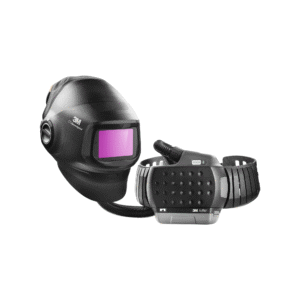
With the current health and safety guidelines having appropriate fume extraction and ventilation has never been more important in the welding & fabrication industry. One solution to this is to have a Powered Air Purifying Respirator or PAPR unit built into the welding helmet. These are referred to as air fed welding helmets.
Within this group of welding helmets there are some recognisable names. 3M Speedglas welding helmets are renowned for their quality and often referred to as the best welding helmet. This does come with a more sizable price tag although other budget friendly options do exist. The CR58S13 Navitek Air Fed Welding/Grinding Helmet is common in industry for its competitive price and flip up visor allowing for a seamless transition from welding to grinding.
What consumables do you need?
Depending on the helmet, different consumables and replaceable parts are needed. Commonly the inner and outer lenses of the welding helmet are the most often replaced and are relatively inexpensive. The Auto Darkening Filter or ADF unit can also be replaced although they should last a few years before needing to be replaced.
For Air-fed welding helmets, there are of course more components that need replacing. Pre-filters and main filters for the P.A.P.R units, batteries, and their chargers.
Depending on the usage, the filters and batteries should need to be replaced once every 6-12 months.
At ESCCO, we pride ourselves on our exemplary service and aftercare, so all helmets we sell are backed up with all the necessary consumables and spares.
Does Helmet weight matter?
Welding helmets do vary in weight, depending on the brand and model of the helmet. Most welding helmets tend to fall between 450 – 650g. To reduce muscle fatigue and the risk of Repetitive Strain Injury (RSI) it is advised to choose the lightest that will still suit your needs and fit within your budget.
How much does a welding helmet cost?
The current market has never been so competitive. As mentioned earlier there is such variety in welding helmets that every budget is covered. If you only want the best welding helmet you can expect to pay a premium price for it. Whereas if you’re a hobbyist welder in need of an auto-darkening welding helmet that will just do the job, you can expect a wide array of inexpensive options.
Looking for the best welding helmet? ESCCO are on hand to help.
We pride ourselves on stocking a wide range of welding helmets, equipment, and consumables for your workshop needs. If there is a product you require that we don’t stock, we’ll endeavour to source it for you.
Email sales@escco.co.uk or call 01432 346190 for expert advice.


